In my first year at UBC I took Fine Arts 125, with H.W. Janson’s History of Art as our text.
As I leaf through Jansen I realize that, although I never planned it, we have visited many places and art works that I loved when I first saw them in that book, either as colour plates like the Ram in the Thicket or as small black and white photos like the Mosque of Córdoba.
A list of some of what I loved then, saw in reality, and still love now:
- the caves of pre-history;
- the bison carved from reindeer horn in the Périgord and the Valley of the Vézère;
- the smile of the Greek Kore and the Erechtheum, Athens;
- the Nike of Samothrace now in the Louvre;
- the Lion’s Gate of Mycenae, c. 1250 BC, where the air trembled and mythic plains lay below;
- Knossos, sea creature pottery from Crete;
- Nefertiti in Berlin;
- Sargon II’s Assyrian court;
- the Villa of Mysteries at Pompeii, elemental red walls, powerful women with swirling draperies, initiation;
- the Christ mosaic in Hagia Sophia, Istanbul;
- Sant'Apollinare in Classe and Theodora in San Vitale, Ravenna;
- the carved beast head prow of the Oseberg ship burial in Oslo;
- the purse cover from Sutton Hoo;
- Giotto in Assisi;
- illuminated manuscripts;
- Notre Dame; Romanesque and Gothic cathedrals;
- the Alhambra in Granada, where paradise meant an abundance of water. When we walked into our early morning viewing, cypresses scented the air. In the evening, bats swooped over the pools.
- the mosque of Córdoba, whose striped receding arches appealed even in black and white. When we entered we saw them, a red and white forest. I avoided looking at the triumphalist Christian section that was inserted into the space in 1236 when Christian forces defeated Al-Andalus.
In the latter part of the book are colour plates of more modern loves whose works we have been privileged to view: Turner, Manet, Monet, Van Gogh, Cezanne, Gauguin, Rouault, Matisse.
I find myself breathless as I finish this list. How have I been so lucky?!!
Treasures of the Human Spirit
I have seen these treasures that embody what a high school friend wrote when he first saw works of art in Europe: “Yes, this is what I, a human being, am.”
Why did these images so strike my soul? Jungians would say that many of them are archetypes, symbols, ancient connections from the collective unconscious. The hefty Taschen Book of Symbols Reflections on Archetypal Images may help my search.
I loved birds on Mesopotamian pots from the first time I saw them, looking as if they danced. Potters, even after their mysterious interactions with earth, water and fire created practical vessels, went beyond those elements to add art and playfulness. The Taschen Book shows a sculpture of a water bird made of mammoth ivory, 30,000 years old: “... someone...was able to move between the worlds—like the bird who can move between the elements—from the outer world of the senses to an inner vision.”
I admire Knossos pottery decorated with the sea creatures, such as the octopus, that were important in their culture. The Taschen Book has much to say about octopuses too, with themes of “the mysteries of dissolution and regeneration”, shape-shifting, and “an encounter with the depths of the psyche”. I like the satisfying round shapes of these pots, shapes I tried for when I made pottery, plus the artist’s design. Besides the encircling octopus’s central head, big eyes and busy tentacles, the artist filled any spaces between with smaller sea urchins, corals, and shells. Exuberance!
Early cultures sculpted humans carrying lambs, long before “The Lord Is My Shepherd” and Bach’s “Sheep May Safely Graze”. I respond to that hope that the vulnerable will be cared for tenderly. Wayne continues to find complete inspiration in the sheep barn he visits, and he has painted hundreds of works which arise from the flocks’ different personalities and emotions. His work links with Bethlehem symbolism and the pastoral tradition. Sitting with the sheep gives him a chance to connect with an expressive animal world. He has to be quiet with them because “If you’re calm, they’re calm. If you’re not, they stampede.” He can’t work with them right now because it is lambing season and an extra presence would increase the ewes’ stress.
I love images of stags with elaborate antlers, from cave art to Scythian bronze and gold, from Hittite standards to the plastic stag, made in China, that I found among Christmas decorations at Capital Iron and which hangs above the computer. The Symbols Book mentions “leafy” antlers and links them to
trees, also to “rejuvenation, rebirth, the ebb and flow of spiritual growth and the passage of time. Stags shed their antlers every winter, and each spring they grow back with an extra branch...”.
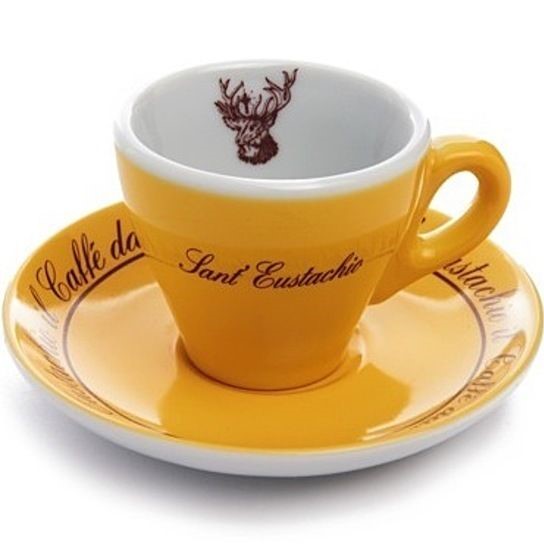
Our friend Father John serves us coffee in cups he bought from the restaurant across from the church of Sant’ Eustachio, a saint revered in the Orthodox tradition, in Rome.
The church of Sant' Eustachio is dedicated to St. Eustace, a legendary Christian martyr, who, according to tradition, was an officer in the army of the emperor Trajan (r. 98-117). Eustace's conversion to Christianity is said to have occurred while he was out hunting, when he was confronted by a white stag, which bore a radiant crucifix between its antlers.
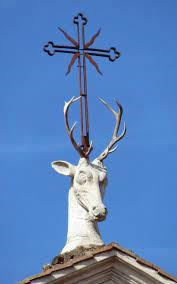
Sant' Eustachio in Rome - Walks in Rome ... walksinrome.com
These images transmute and retain their power.
The Ram in the Thicket, which I visit every time I go to the British Museum, is part of this symbol family too. It was formed from precious gold and lapis lazuli circa 2600 BC. Its twin, held in Philadelphia, is the one pictured in Jansen.
Images of mother and child are central to me; nothing is more important than the nurturance of babies.
Such images connect with reverence for women’s often underestimated power, child-bearing, survival and protective knowledge passed on. The religion of my youth formed me in many ways and I remain grateful that Mary, Our Lady, was a presence in the gospel, the iconography and our prayers: “Ave Maria”, “Hail Mary, full of grace”. From early amulets to the grace of Notre Dame to countless Madonna and Child figures, the mother/babe archetype is potent.
I was brought up in the ritual and ceremony of the Mass which connected me to masses held anywhere in the world. When all were celebrated in Latin, we knew that we could walk into any church and be part of it. “Thou art Peter; and upon this rock I will build my church.” St. Peter’s in Rome and 2000 years of history were ours too.
I continued to be interested in church history when I studied Medieval History at UBC. I wrote an essay on the larger-than-life Cappadocian Fathers, Gregory of Nazianza , Gregory of Nyssa and Basil the Great. Wayne and I regret that we became too sick in the summer heat of Turkey to travel to Cappadocia where the hoodoos, “fairy chimneys” landscape, was carved out underground to create havens for persecuted Christians and all locals under siege.
Another overwhelming image is that of “Temple”, sacred spaces. We have visited many cathedrals, especially in Great Britain and France. In every one we appreciated the quiet and offered our deep respect for the builders and craftsmen who created them.
Author Ken Follett states: My lifelong passion for these places is more than just the architecture. When you go into a cathedral, you find yourself enveloped by a feeling of peace – it’s like a rest for your soul, especially in the busy 21st century. I walk into a cathedral and feel that I want to sit down and let that wash over me.
The Symbols Book gives the derivation of “temple” as the Greek temenos, “a secluded realm”. We have been privileged to enter realms large and small: standing stones, niches with lit candles, circles of joined hands, the cave and spring of the Delphi Oracles, holy wells in Ireland that hark back to pagan practices, Ireland’s Mass Rocks which were secret locations for Masses during Penal Laws times when it was illegal to celebrate openly.
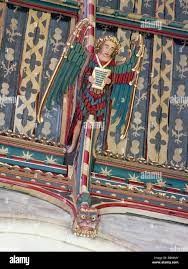
In Britain, Ely Cathedral is my favourite. It has been called “The Ship of the Fens” as its wonderful lantern rises in that low-lying area. Inside, painted angels on high have insipid expressions and are probably nineteenth century but nevertheless remind me of one of my favourite books, D. L. Sayers’ Nine Tailors, which was set in fen country. Horses grazed outside when we first visited, and the depression which was the monk’s fish pond is still obvious. Once when we entered, a cheerful Bishop was addressing groups of children who sat on the floor. The place was alive. During a break we saw children sliding along the floor of the Lady Chapel.
Because we had friends in Ely, we returned to the cathedral several times in different years and lights.
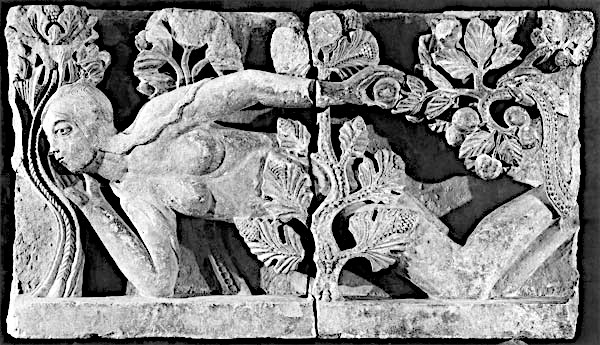
When Wayne retired in 2004 we each listed our top three destinations for an epic nine week journey. Romanesque cathedrals in the south of France were one of Wayne’s choices so we spent time in Vézeley on the Chemin de St. Jacques pilgrim route and Moissac with its sculptures on the Abbey front and the capitals of its cloister. The epitome of the 12th century sculptures are those of Gislebertus in Saint-Lazare, Cahors, many of which have been removed upstairs so we can view them in the round and at eye level. Wayne had dreamed of seeing them since he had seen photos in Horizon Magazine when he was sixteen.
In Moissac, when we mailed all our postcards of Autun plus Lascaux and other caves, we could not overcome the postal clerk’s insistence that we did not need a customs declaration to mail our package to Canada. When that package was therefore lost, Wayne wrote to the Autun cathedral, asking if they would re-send a copy of every postcard to us.
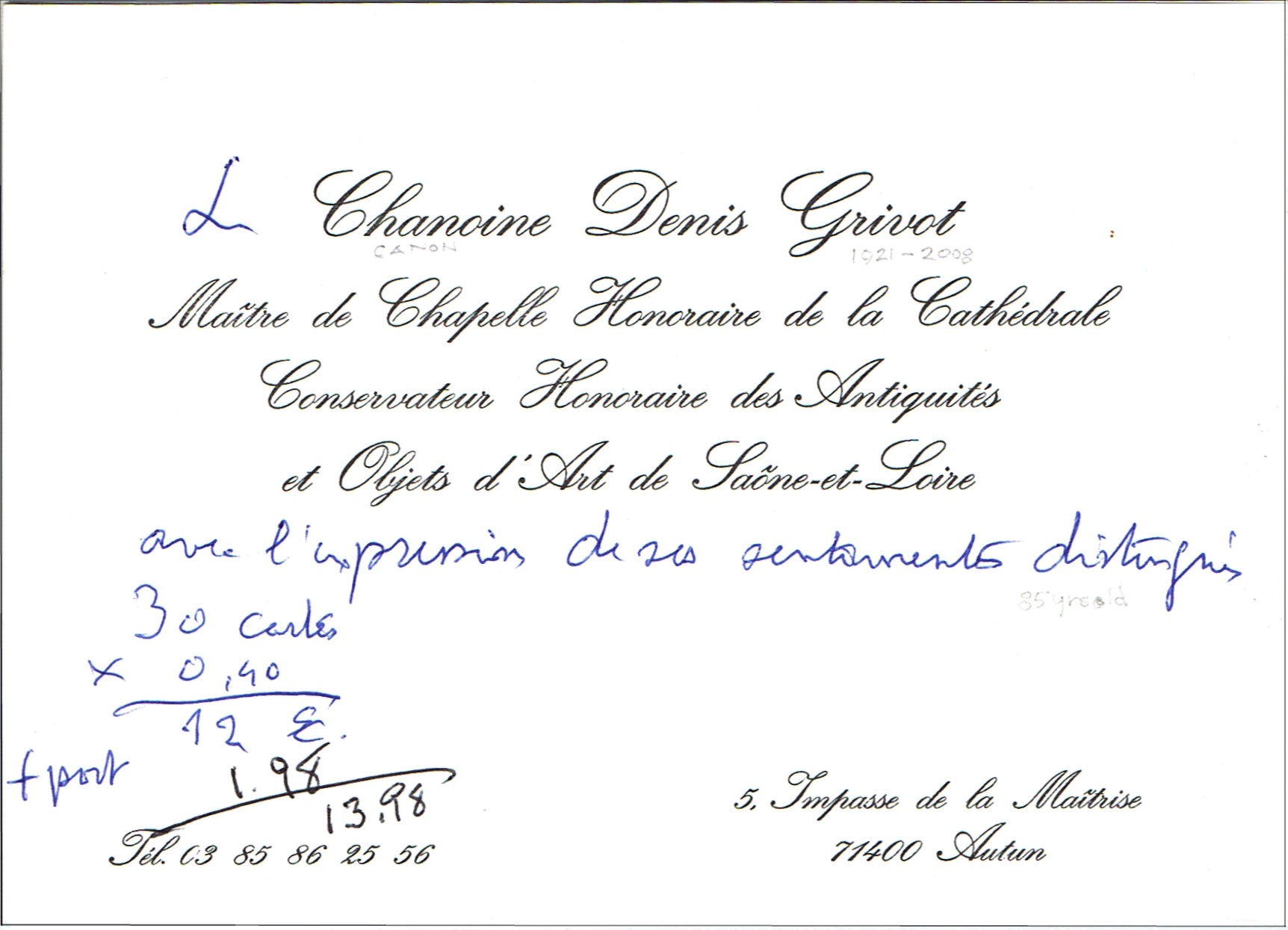
Wayne received a parcel of cards from M. Grivot “avec l’expressions de ses sentiments distingué” with M. Grivot’s card and the amount owed. Unknown to us, the kind M. Grivot was “”Le Chanoine (Canon) , Maitre de Chapelle Honoraire de la Cathédrale Conservateur Honoraire des Antiquités et Objets d’Art de Saône-et-Loire”. When Wayne relooked at his treasured definitive Gislebertus, Sculptor of Autun book, published in 1961, he was surprised to see the authors: Denis Grivot and George Zarnecki.
Autun Cathedral
Eve, in a dream,
absentmindedly
plucks an apple.
W Gislebertus
Three More from Gislebertus –
titles in French from our postcards from Autun. J.
They Are Used To Luxury
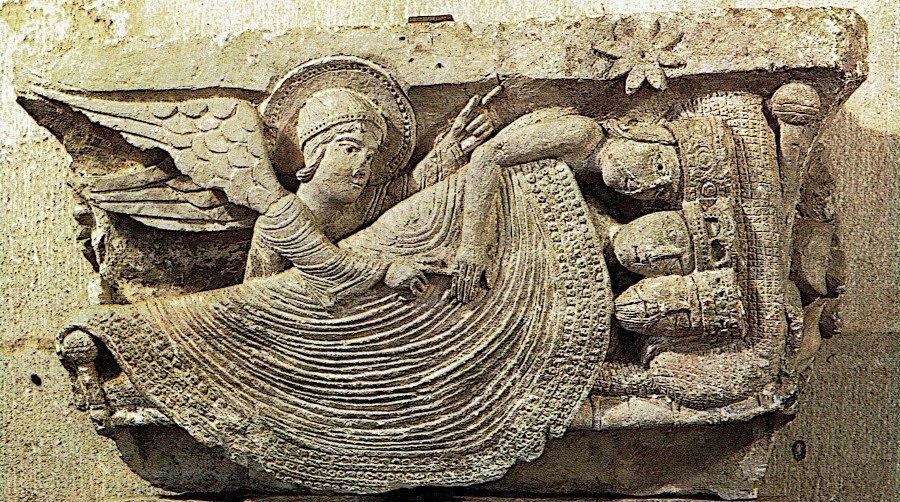
One tender blanket
covers the kings who accept
the star's bright summons.
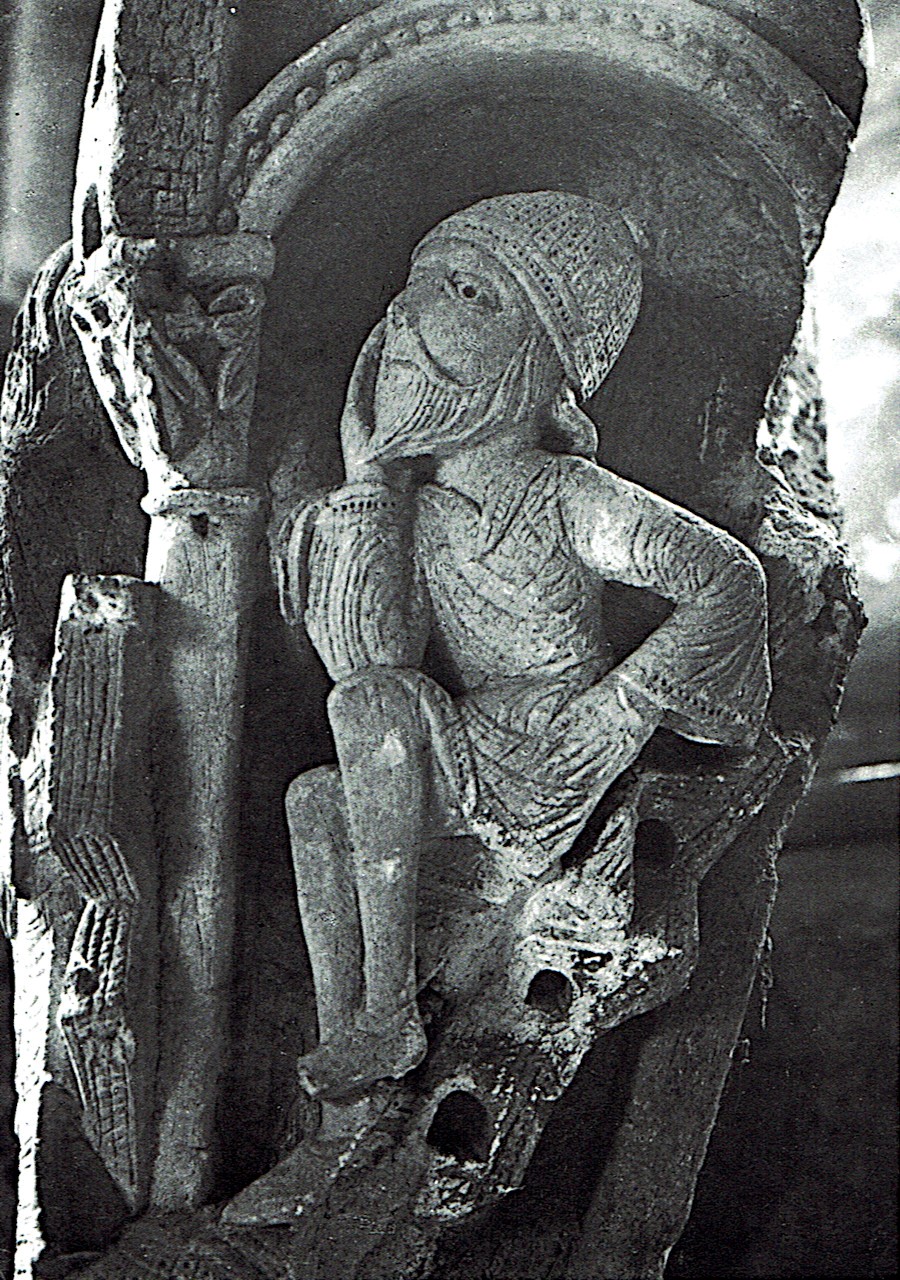
Épiphanie
Disgruntled Joseph
chin in hand, a bit player
after all his work --
so human in this drama
of the divine.
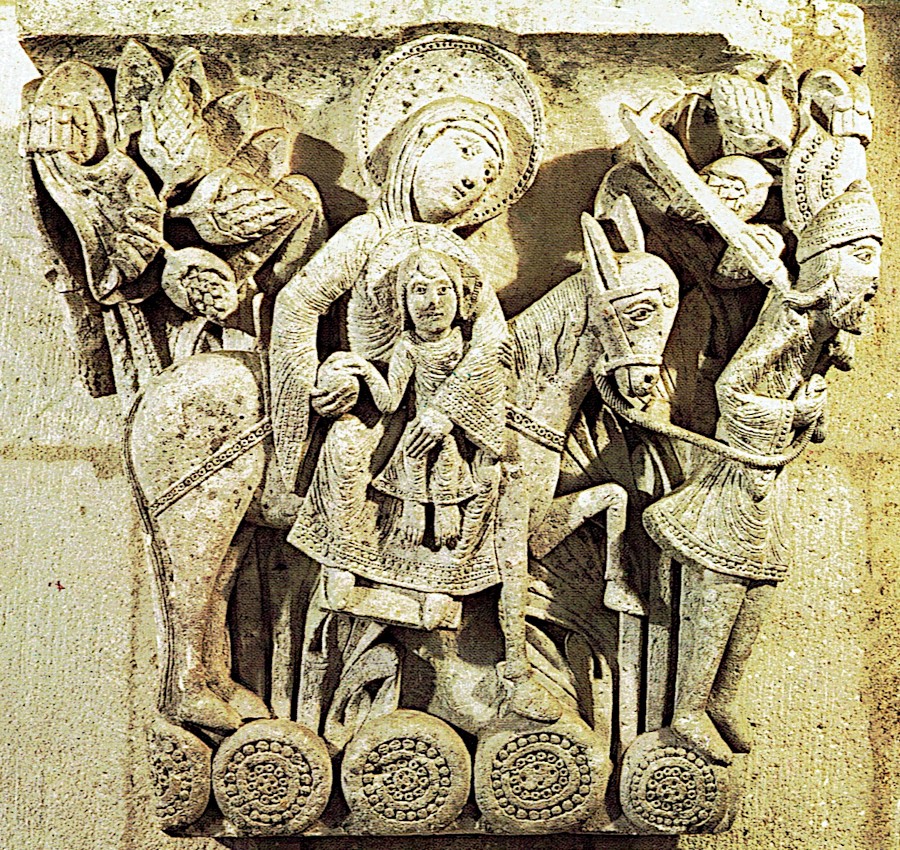
Fuite en Egypte
Joseph Is Given A Dream
Stalwart Joseph must
lead his family from danger --
refugees into Egypt.
(Haiku above are from our ongoing project with our friend Leta. Leta mentioned apples and we built from there).
Janson and Me Jane Thom February 2022.
In my first year at UBC I took Fine Arts 125, with H.W. Janson’s History of Art as our text.
As I leaf through Jansen I realize that, although I never planned it, we have visited many places and art works that I loved when I first saw them in that book, either as colour plates like the Ram in the Thicket or as small black and white photos like the Mosque of Córdoba.
A list of some of what I loved then, saw in reality, and still love now:
- the caves of pre-history;
- the bison carved from reindeer horn in the Périgord and the Valley of the Vézère;
- the smile of the Greek Kore and the Erechtheum, Athens;
- the Nike of Samothrace now in the Louvre;
- the Lion’s Gate of Mycenae, c. 1250 BC, where the air trembled and mythic plains lay below;
- Knossos, sea creature pottery from Crete;
- Nefertiti in Berlin;
- Sargon II’s Assyrian court;
- the Villa of Mysteries at Pompeii, elemental red walls, powerful women with swirling draperies, initiation;
- the Christ mosaic in Hagia Sophia, Istanbul;
- Sant'Apollinare in Classe and Theodora in San Vitale, Ravenna;
- the carved beast head prow of the Oseberg ship burial in Oslo;
- the purse cover from Sutton Hoo;
- Giotto in Assisi;
- illuminated manuscripts;
- Notre Dame; Romanesque and Gothic cathedrals;
- the Alhambra in Granada, where paradise meant an abundance of water. When we walked into our early morning viewing, cypresses scented the air. In the evening, bats swooped over the pools.
- the mosque of Córdoba, whose striped receding arches appealed even in black and white. When we entered we saw them, a red and white forest. I avoided looking at the triumphalist Christian section that was inserted into the space in 1236 when Christian forces defeated Al-Andalus.
In the latter part of the book are colour plates of more modern loves whose works we have been privileged to view: Turner, Manet, Monet, Van Gogh, Cezanne, Gauguin, Rouault, Matisse.
I find myself breathless as I finish this list. How have I been so lucky?!!
Treasures of the Human Spirit
I have seen these treasures that embody what a high school friend wrote when he first saw works of art in Europe: “Yes, this is what I, a human being, am.”
Why did these images so strike my soul? Jungians would say that many of them are archetypes, symbols, ancient connections from the collective unconscious. The hefty Taschen Book of Symbols Reflections on Archetypal Images may help my search.
I loved birds on Mesopotamian pots from the first time I saw them, looking as if they danced. Potters, even after their mysterious interactions with earth, water and fire created practical vessels, went beyond those elements to add art and playfulness. The Taschen Book shows a sculpture of a water bird made of mammoth ivory, 30,000 years old: “... someone...was able to move between the worlds—like the bird who can move between the elements—from the outer world of the senses to an inner vision.”
I admire Knossos pottery decorated with the sea creatures, such as the octopus, that were important in their culture. The Taschen Book has much to say about octopuses too, with themes of “the mysteries of dissolution and regeneration”, shape-shifting, and “an encounter with the depths of the psyche”. I like the satisfying round shapes of these pots, shapes I tried for when I made pottery, plus the artist’s design. Besides the encircling octopus’s central head, big eyes and busy tentacles, the artist filled any spaces between with smaller sea urchins, corals, and shells. Exuberance!
Early cultures sculpted humans carrying lambs, long before “The Lord Is My Shepherd” and Bach’s “Sheep May Safely Graze”. I respond to that hope that the vulnerable will be cared for tenderly. Wayne continues to find complete inspiration in the sheep barn he visits, and he has painted hundreds of works which arise from the flocks’ different personalities and emotions. His work links with Bethlehem symbolism and the pastoral tradition. Sitting with the sheep gives him a chance to connect with an expressive animal world. He has to be quiet with them because “If you’re calm, they’re calm. If you’re not, they stampede.” He can’t work with them right now because it is lambing season and an extra presence would increase the ewes’ stress.
I love images of stags with elaborate antlers, from cave art to Scythian bronze and gold, from Hittite standards to the plastic stag, made in China, that I found among Christmas decorations at Capital Iron and which hangs above the computer. The Symbols Book mentions “leafy” antlers and links them to
trees, also to “rejuvenation, rebirth, the ebb and flow of spiritual growth and the passage of time. Stags shed their antlers every winter, and each spring they grow back with an extra branch...”.
Our friend Father John serves us coffee in cups he bought from the restaurant across from the church of Sant’ Eustachio, a saint revered in the Orthodox tradition, in Rome.
The church of Sant' Eustachio is dedicated to St. Eustace, a legendary Christian martyr, who, according to tradition, was an officer in the army of the emperor Trajan (r. 98-117). Eustace's conversion to Christianity is said to have occurred while he was out hunting, when he was confronted by a white stag, which bore a radiant crucifix between its antlers.
Sant' Eustachio in Rome - Walks in Rome ...
These images transmute and retain their power.
The Ram in the Thicket, which I visit every time I go to the British Museum, is part of this symbol family too. It was formed from precious gold and lapis lazuli circa 2600 BC. Its twin, held in Philadelphia, is the one pictured in Jansen.
Images of mother and child are central to me; nothing is more important than the nurturance of babies.
Such images connect with reverence for women’s often underestimated power, child-bearing, survival and protective knowledge passed on. The religion of my youth formed me in many ways and I remain grateful that Mary, Our Lady, was a presence in the gospel, the iconography and our prayers: “Ave Maria”, “Hail Mary, full of grace”. From early amulets to the grace of Notre Dame to countless Madonna and Child figures, the mother/babe archetype is potent.
I was brought up in the ritual and ceremony of the Mass which connected me to masses held anywhere in the world. When all were celebrated in Latin, we knew that we could walk into any church and be part of it. “Thou art Peter; and upon this rock I will build my church.” St. Peter’s in Rome and 2000 years of history were ours too.
I continued to be interested in church history when I studied Medieval History at UBC. I wrote an essay on the larger-than-life Cappadocian Fathers, Gregory of Nazianza , Gregory of Nyssa and Basil the Great. Wayne and I regret that we became too sick in the summer heat of Turkey to travel to Cappadocia where the hoodoos, “fairy chimneys” landscape, was carved out underground to create havens for persecuted Christians and all locals under siege.
Another overwhelming image is that of “Temple”, sacred spaces. We have visited many cathedrals, especially in Great Britain and France. In every one we appreciated the quiet and offered our deep respect for the builders and craftsmen who created them.
Author Ken Follett states: My lifelong passion for these places is more than just the architecture. When you go into a cathedral, you find yourself enveloped by a feeling of peace – it’s like a rest for your soul, especially in the busy 21st century. I walk into a cathedral and feel that I want to sit down and let that wash over me.
The Symbols Book gives the derivation of “temple” as the Greek temenos, “a secluded realm”. We have been privileged to enter realms large and small: standing stones, niches with lit candles, circles of joined hands, the cave and spring of the Delphi Oracles, holy wells in Ireland that hark back to pagan practices, Ireland’s Mass Rocks which were secret locations for Masses during Penal Laws times when it was illegal to celebrate openly.
In Britain, Ely Cathedral is my favourite. It has been called “The Ship of the Fens” as its wonderful lantern rises in that low-lying area. Inside, painted angels on high have insipid expressions and are probably nineteenth century but nevertheless remind me of one of my favourite books, D. L. Sayers’ Nine Tailors, which was set in fen country. Horses grazed outside when we first visited, and the depression which was the monk’s fish pond is still obvious. Once when we entered, a cheerful Bishop was addressing groups of children who sat on the floor. The place was alive. During a break we saw children sliding along the floor of the Lady Chapel.
Because we had friends in Ely, we returned to the cathedral several times in different years and lights.
When Wayne retired in 2004 we each listed our top three destinations for an epic nine week journey. Romanesque cathedrals in the south of France were one of Wayne’s choices so we spent time in Vézeley on the Chemin de St. Jacques pilgrim route and Moissac with its sculptures on the Abbey front and the capitals of its cloister. The epitome of the 12th century sculptures are those of Gislebertus in Saint-Lazare, Cahors, many of which have been removed upstairs so we can view them in the round and at eye level. Wayne had dreamed of seeing them since he had seen photos in Horizon Magazine when he was sixteen.
In Moissac, when we mailed all our postcards of Autun plus Lascaux and other caves, we could not overcome the postal clerk’s insistence that we did not need a customs declaration to mail our package to Canada. When that package was therefore lost, Wayne wrote to the Autun cathedral, asking if they would re-send a copy of every postcard to us.
Wayne received a parcel of cards from M. Grivot “avec l’expressions de ses sentiments distingué” with M. Grivot’s card and the amount owed. Unknown to us, the kind M. Grivot was “”Le Chanoine (Canon) , Maitre de Chapelle Honoraire de la Cathédrale Conservateur Honoraire des Antiquités et Objets d’Art de Saône-et-Loire”. When Wayne relooked at his treasured definitive Gislebertus, Sculptor of Autun book, published in 1961, he was surprised to see the authors: Denis Grivot and George Zarnecki.
Autun Cathedral
Eve, in a dream,
absentmindedly
plucks an apple. W
Gislebertus
Three More from Gislebertus –
titles in French from our postcards from Autun. J.
Sommeil des Mages
They Are Used To Luxury
One tender blanket
covers the kings who accept
the star's bright summons.
Épiphanie
Disgruntled Joseph
chin in hand, a bit player
after all his work --
so human in this drama
of the divine.
Fuite en Egypte
Joseph Is Given A Dream
Stalwart Joseph must
lead his family from danger --
refugees into Egypt.
(Haiku above are from our ongoing project with our friend Leta. Leta mentioned apples and we built from there).