June 23, 24, 2025
I just returned from the Lighthouse, where there are beautiful new seats decorated with Indigenous art, where you can watch the swimming seals, listen to the horns of the passing ferries, enjoy the light breeze off the water, and watch the soaring eagles. It was a good time and place to think about Hymie.
My old friend breathed his last breath yesterday. Although I hadn’t seen him in 55 years, I was always conscious of him. I’m not grieving; rather, I’m celebrating a life lived the way he wanted to live it. Dear Hymie, may your memory be a blessing to many.
I met Hymie in the spring of 1968, when I moved into the flat on Jeanne-Mance Street, east of McGill University, that that Liz, Lizette, and Sue were renting.
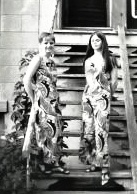
He was a medical student at McGill. He seemed to know Sue best. They sat up late one night, talking, at the kitchen table, while I was sleeping in the tiny room at the back of the kitchen, the maid’s room, I guess, or maybe a pantry in former times.
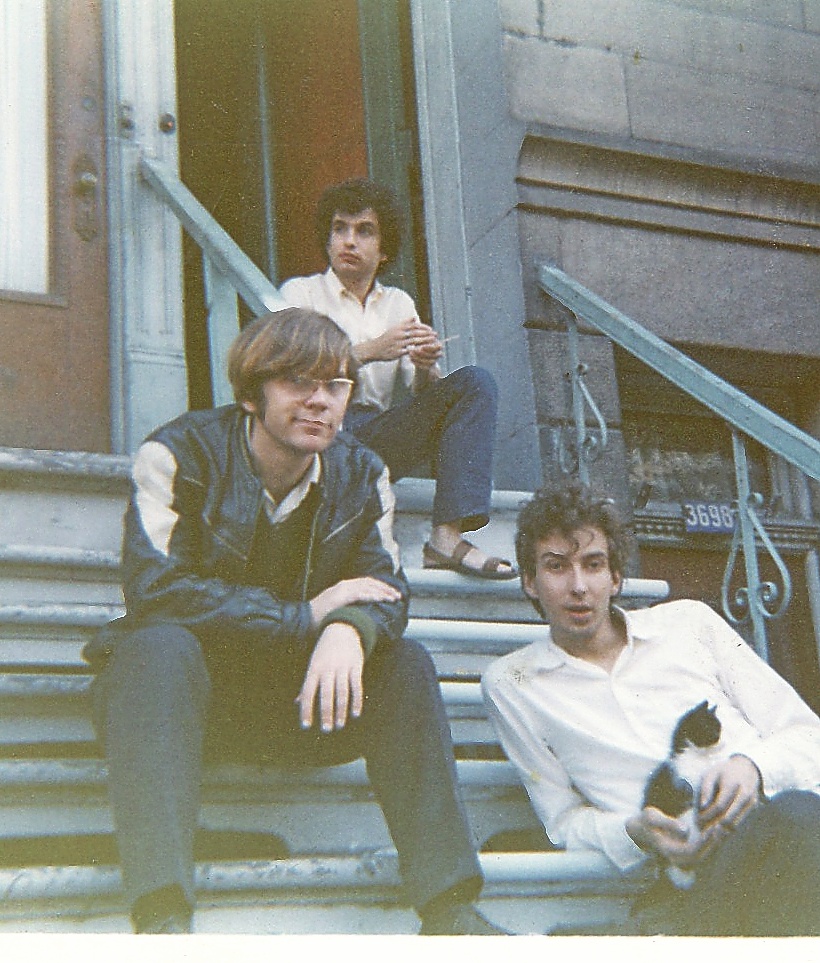
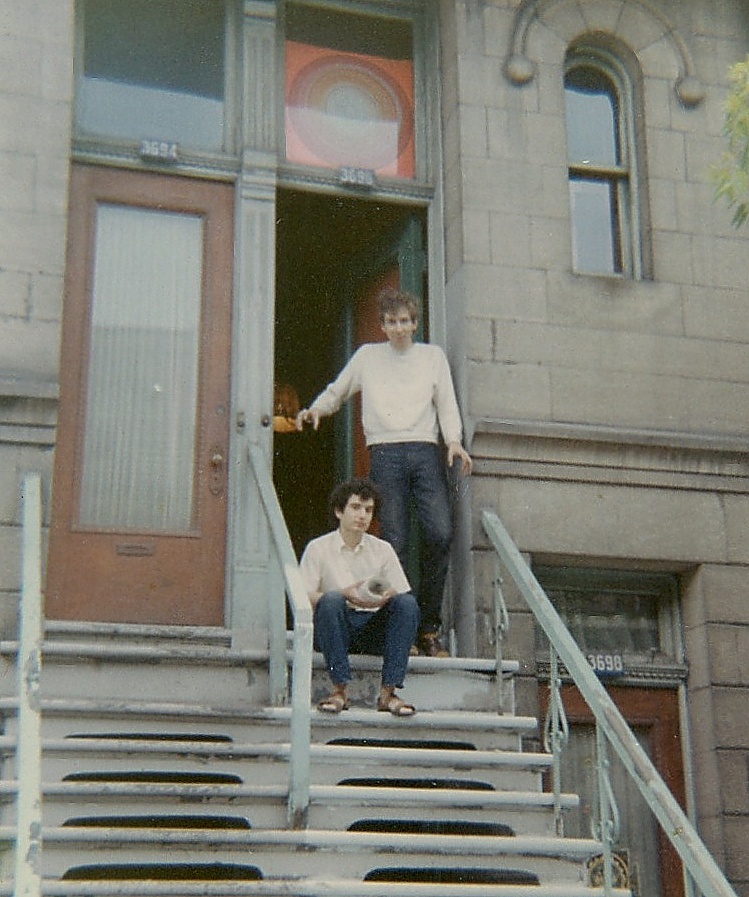
Guys around the place
 |
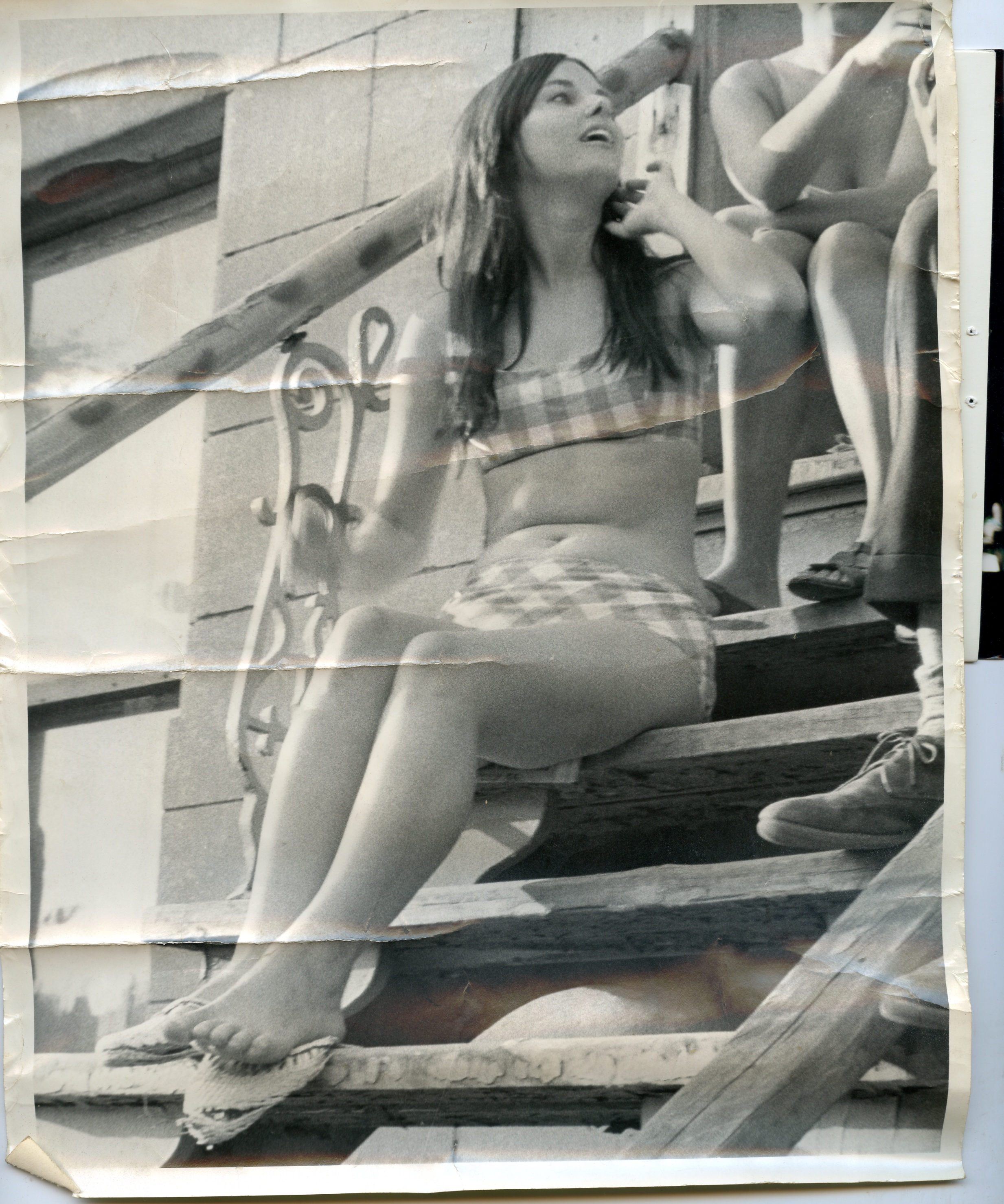 |
Pic 1: Dai / Hymie / Joel w Letta
Pic 2 Hymie w Letta, Joel |
Hymie and I got to know each other better as the summer wore on. He purchased a little Peugeot and we went for a few rides. I remember one ride very well. We were looking at old farms and admiring the barn wood. He told me I was “as natural as the grass,” which I took as a compliment. I think he meant it that way. He was a kind person and also very honest. We picked up an old man who was hitchhiking that day. Hymie asked in his open way if the man ever stole from people who picked him up. The old man replied that there was no need to rob people, that people were kind. I felt a little uncomfortable, but I don’t think either of them felt uncomfortable, the way I did.
I remember looking at the side of Hymie’s face at one point in the drive, and he asked me what I was doing “Looking at you objectively,” I replied. “Don’t,” he said. “Don’t look at me objectively.” I apologized and agreed not to do that again. I don’t think I did.
One day Hymie and I went for a walk on Mt Royal and he introduced me to the Jewish cemetery. He talked about the respect that went with rituals around dying and being buried. I don’t remember all of what he said, but I do know he was serious and clearly felt something for the rites involved in honouring the dead. I have been wondering about this. Around the time we visited the graveyard, he took me to his parents’ house, and I met his mum and dad. They were sweet to me. I said that Hymie had told me his mother played the balalaika and she graciously showed her instrument to me.
Hymie took me to the apartment he shared with two other med students. The apartment was very austere, clean, and minimalist. The roommates were not at home, and he told me that they would unquestionably not have wanted him to bring a girl there. The three students had an agreement, but he broke it in my case. A large poster of Bertrand Russell was hung on Hymie’s bedroom wall, the only non-functional item in the whole place. It was at that apartment that Hymie broke down and let his deep sadness out. For the first time, I saw how much emotional pain he was in.
Soon, he was moving to Toronto to take up work in one of the hospitals there. Was he an intern? A resident? I don’t know. We wrote to each other, and he told me how unhappy he was. I tried to cheer him up, but to no avail. So I took the train to Toronto to see him. I guess he told his parents that I was going to see him because he arranged for them to meet me at the apartment he had rented as a student, and they handed me some personal items, mostly clothes, that he would need, which I added to my suitcase.
Hymie was living in a big house in Toronto with a few other people. The main renters were a couple. He ran a print shop that put out a comic strip. I forget what she did. There was a very strange woman living there called Bear. She stood for long periods of time, sometimes on the stairs, perhaps catatonic. Hymie and I slept in the hospital residence, just an open room with a bunch of beds where I guess residents or interns slept when on call. There was nobody else around, that I saw, anyway. He and I had to visit around his schedule. The next time I went to see him, he took me to meet a couple who lived in a nice home, and we had dinner and listened to music. It was quite a change from the first place. That was the last time I visited him.
The next time we saw each other, he came to the place Joel and I were now living in on Jeanne-Mance. He brought a friend along, a nice young man whose name I forget. I think this was around the time he dropped out of medical life and was seriously looking for something else. After that, he moved into our flat and began making sandals out of soft leather and rubber tires, very nice, like Birkenstocks. I wish I had a pair!
I went out west to visit my family in the summer of 1969, while Hymie lived with Joel. Joel remembers him going away, perhaps to New York, and coming back with a shaved head, white lines on his face, saffron clothes, and a grin from ear to ear.
That’s when he moved into the Krishna Temple. One day he drove past our house in his Peugeot with a bunch of Krishna “freaks” hanging out the windows and laughing happily. He sold his car then and gave the money to the temple on Pine Street, over the pizza parlour, in Montreal. Whenever we visited the temple, he was busy doing things. I recall what might have been the last time I saw him there. He was fixing their sound system, smiling and chuckling, while “Hare Krishna” played on a small record player.
I went to the temple a couple of years after he had gone and stayed for a weekend. I guess I wanted to discover the appeal. It was lovely in some ways, with a strong sense of community, but it was not for me. Some people loved getting up at 5:00, cold showering while chanting, sitting sleepily in a circle listening to someone read from the Bhagavad Gita, chanting, placing food before the gods and goddesses, watering holy plants, and so on, but I failed to see the attraction. I guess it was Hymie’s love for his guru, A.C. Bhaktivedanta Swami, Prabhupada, that made it so wonderful for him and gave him the sense that this was who he was and what he needed to do. It took away all his sadness and made him happy. Anyway, I was happy that Joel and our baby Jason were waiting for me at Crow’s Nest, our little home in the Eastern Townships of Quebec.
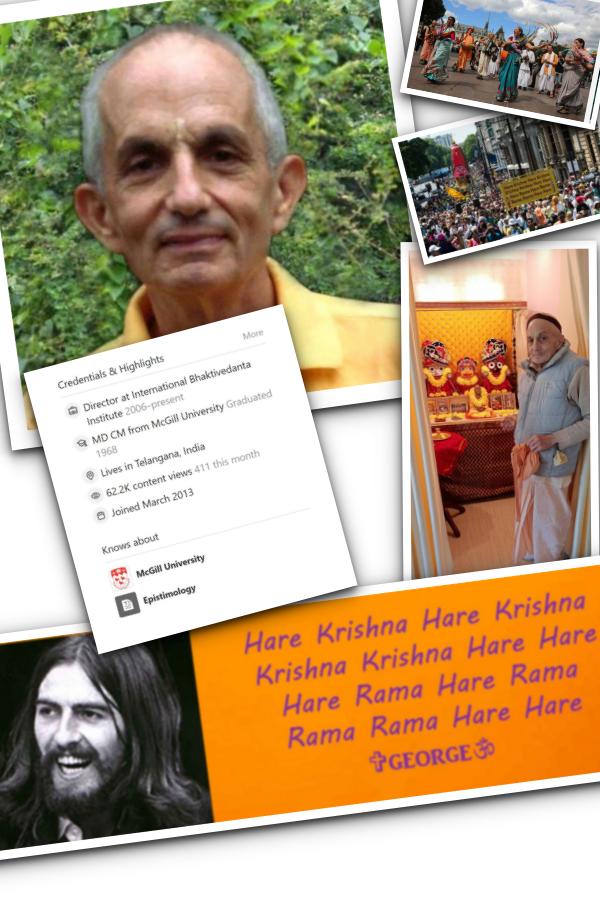
Hymie never stopped being a doctor, Hyman Zuckerman MD CM. He used his brilliance and knowledge to help others. He did anything that was expected of him. He gave talks to his followers, some of which were recorded and are listed below. Apparently, he was also known and appreciated for designing and making Rathayatra carts, very fancy carts for use in rituals.
As Rasananda das Bramachari, he was the Founding Director of the International Bhaktivedanta Institute, A Vedic-paradigm-based Center for Scientific and Historical Research and Communication. We discovered on Facebook that Hymie’s parents left him an inheritance, which he used to purchase an apartment and ashram. I hope that gave him some comfort as he aged. He also wrote a book about the kirtan as taught to him by his Prabupada, titled Proper Kirtan. He adds a note about the book: “Upon joining the movement in 1969, among other services, I (the author) was assigned to look after the temple’s “library” consisting of the Collier Bhagavad Gita, Teachings of Lord Caitanya, Sri Isopanisad, a set of Prabhupada’s Indian printed first canto Srimad Bhagavatam volumes, photocopies of letters from Prabhupada on his instruction circulated to all the then four or five temples, a few reel-to-reel tapes of Prabhupada’s bajans and kirtans, the ‘Happening’ album, one or two 45 records and maybe one or two other books. Among the letters was one in which Prabhupada says about authorized chants that they include govinda jaya jaya gopala jaya jaya, radha ramana hari govinda jaya jaya and gopala, gopala, yasodanandana gopala. As this letter does not appear in Folio, I did not include them among the references to authorized mantras.”
Devotee
 |
 |
 |
Though he was a devotee of Krishna, he was also a Jew, and I hope someone in his friends or family group will give his life and memory their respect. May his memory be a blessing.
And now let me address you, as my friend Hymie, or as HG Rasananda Prabhu, or by your name as author of the book, Rasananda dasa Brahmacari, disciple of His Divine Grace AC Bhaktivedanta Swami Srila Prabhupada. I will always remember you as I knew you, as Hymie Zuckerman, a young man looking for Truth, and I will honour you by your other names as well, as you followed your path and completed your time in your body to the best of your ability.
Amber Harvey
----------------------------------------------------------
From the Brandon Sun on February 27, 1971 >>?> Picture
Finds ...

This article, "Finds satisfying life in Krishna," was published in The Brandon Sun, February 27, 1971, in Brandon, Canada.
TORONTO (CP) - Hyman Zuckerman found his life unsatisfying so he changed his name to Rasananda Das Brahmachary and instead of practising medicine he became a disciple of a cult known as Krishna Consciousness.
Rasananda, 27, received his medical degree from McGill University last spring but instead of going into practice he moved into one of the cult's temples in Toronto.
In the temple where the air is redolent with the fragrance of burning incense and Indian cooking spice, Rasananda explained in an interview:
"Like the other disciples, I joined Krishna because my other life was unsatisfying."
The sect was established in the 1960s in New York by A. C. Bhaktivedanta Swami Prabhupad. Followers believe self-realization and self-purification can only be achieved through close union with Krishna, another word for the Lord.
They believe in reincarnation, vegetarianism, non-violence and kindness to all living things. The main activities are study and devotion. Wealth, alcohol, drugs, coffee, tea, meat, gambling and sex outside marriage are outlawed.
"We don't miss any of it because we have Krishna," said Rasananda. "Drugs we can especially do without."
"Most people seek pleasure in things like sex, food, drink, hockey, movies and TV. It's a waste of time because those things are emphemeral, unreal and unimportant. The only hope of fulfilment is through a life of utter devotion to Krishna."
Krishna means the all-attractive. One of the cult's main activities is the chanting of the mantra.
"The mantra is Krishna in sound," said Rasananda. "It glorifies him and summons people to worship him. When we chant privately in the temple, it's the genuine crying of a child for his mother."
The daily schedule for the 22 members in the Toronto temple begins at 4 a.m. The men shave their faces and heads clean, leaving a small tuft of hair on the crown.
"Our hair-style is a symbol of renunciation and also serves as an identification tag so Krishna can recognize us," said Rasananda.
The next four hours are spent in praying, chanting, studying and offering food at the altar for Krishna's blessing.
Breakfast is served at 8 a.m. with the men sitting on the floor around a rectangular bamboo mat and the women sitting around another.
The menu consists of plain yogurt, a cooked cereal and milk.
During the day, some disciples are assigned to household chores and others chant the mantra.
In late afternoon they gather again for prayer and devotion, eat a meal and by 10 p.m. the temple is dark and silent.
"We get along nicely on six hours sleep a night." said Rasananda. "We only stay in bed long enough to get rested to serve Krishna the next day. In the materialistic world, people use sleep as an escape from life."
His talks can be seen and heard at https://www.youtube.com/watch?v=_Xe7jumyT74
Typical FaceBook Commentary..