It was named for Imperial Oil, a prominent feature in the neighbourhood, which employed many of the residents, I think. The smell was the first thing you noticed, the gassy smell from the oil refinery, and the second thing was the flame, that shone in my bedroom every night, my faithful night light.
The house we bought was brand new, a two bedroom, four-room house. There was no running water and no indoor toilet. There was no bathroom, not even an empty room where bathroom facilities could be added.
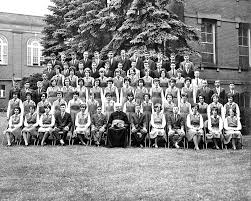
We arrived on Hallowe’en, October 31, 1953. I was eight years old. On November 1, Mum and I walked to Imperial School, where we were registered and where the school nurse checked my head for lice! Mum took me home again and I started the next morning, walking there alone since Mum and Shelagh went together to Simpson’s Sears to apply for work.
I was seated at the back of Miss Cranch’s grade three classroom. The kids called her “Crabby Cranch” behind her back, and she certainly was strict! I was terrified of her, and only slightly less afraid of my classmates. A straight A student for the first two years of school, I received a D in Oral Language on my first report card and was devastated. I could speak but was horribly shy and barely spoke a word for the first couple of months. My favourite activity was to finish my work quickly, which I found boringly unchallenging, and ask to use the bathroom. I loved the lovely long, empty hallway and the huge, empty girls’ bathroom with all its toilets and sinks and mirrors.
Winter came quickly and my long walk to school started as soon as my parents and sister left the house. I slipped into my coat, pulled on my hat and boots, wrapped the scarf around my face, put on my double pair of mittens, picked up my pink tin lunchbox, and left, making sure I locked the door and tucked the key back inside my coat.
The road was unpaved, and the wooden sidewalk was slippery underfoot. Regina’s earth was known as gumbo, and when wet it clung to your boots. When frozen, it lay in chunks and grooves where the tires of passing cars had churned it up.
I always walked alone. Nobody else was out except for trucks delivering groceries to the nearby grocery store. Nobody else left for school before eight o’clock. By the time I reached school there was another half hour to wait before the nine o’clock bell rang. I stood outside the school doors, shifting from one cold foot to the other, watching the teachers go by, my breath fogging up the window. Nobody was happier than me when the bell rang, and a teacher opened our door so I could enter the toasty oven of a school. It was heaven.
The first children I got to know were two girls from my neighbourhood, not from the new houses, but from the older, even worse houses. Darlene and Iris had been living here all their lives, and had siblings who were in this school, though I never knew them. Darlene was a big girl. She was the eldest in her family. I only went to her house once, and met her mother, a hugely obese woman. A loaf of white, sliced bread and a jar of peanut butter stood on the table. Her mother never rose from her couch.
I never visited Iris at home. She was a thin, pale girl. Her eyelashes seemed perpetually gummy and her skin was dry. At recess, the three of us and sometimes a few others would stand in the shelter of the school and make ice with our boots by sliding them back and forth over the snow. I was tempted to touch my tongue to the metal screens over the windows but resisted, with great difficulty. Iris told jokes. They were dirty jokes, I guess, but because I had no idea what sex was, I never got the jokes. I remember one that puzzled me a lot because it was about pouring ink on the bed. This seemed like a terrible thing to do and I knew that I would never do that, but the girls in the joke spilled first red and then green ink in the bed, perhaps to do with a way of celebrating Christmas. And their father wasn’t mad at them. He just told them if they were “ready” or not, depending on the colour.
Another girl who sometimes joined us was a victim of polio. She had one very short leg and walked with crutches. She was small for her age. She sometimes talked about the nurses in the hospital, but I don’t recall what she told us about them. All in all, I found my group of friends to be uninspiring, but they kept me from being all alone.
As the year progressed and I became more vocal, and as my answers when the teacher asked us a question proved that I had a brain, another two friendships developed. Verna and Arlene were friends already and they made me their friend, too. We first bonded over books. The Bookmobile came to the school every couple of weeks and I always headed for the fairy tales. Verna and Arlene and I talked about the books we were reading. I found them more congenial than the other girls, but I always felt like a third wheel and it was still a lonely feeling.
During the summer I tried to get Darlene and Iris interested in “putting on a show” with me. Iris wasn’t around, but Darlene came over and we set up a curtain in the basement and practised songs I’d seen in musicals, for a very small audience of one or two children and their baby brothers.
I remember a boy named Jackson who played ball hockey during my first winter at Imperial School. He and his friends played on the field at recess. He wore black rubber boots folded down at the top to make a cuff. For some unknown reason were called “Stibbs.” He was the goalie. and I loved watching him move. I had a secret crush on him from the first time I saw him play. I felt this way about him until I left Imperial School in the early part of 1956 and attended Strathcona School. I was sad to leave my friends and I hardly ever saw them again, but at least I now knew how to make new friends.
Fast forward to the spring of 1964. I was nineteen years ole and was hanging clothes out on the line in our back yard. Around the corner of the house came Darlene. I’d have known her anywhere. She hadn’t changed much in the seven years since I’d left her behind in our Grade Six classroom. She said she had come to tell me something wonderful. There was a friend, a man, waiting for her in a car out front. He was taking her to California, where he was going to teach her to dance! He was going to make her a dancer. Wasn’t that going to be exciting?
We sat down on the back step and I listened to her tell me excitedly about this development in her life. I didn’t know why she was telling me this. I hardly knew her, hadn’t seen her in seven years, and she had never been to my place or phoned me or made any contact whatsoever with me. And here she was, stopping off on her way to California with a man, and taking the time to tell me about it, almost a total stranger.
I’m usually pretty slow to recognize a scam, but a little red flag went up. This was all too strange not to be wrong in some way. For one thing, I could not imagine Darlene as a dancer. She did not have what people thought of as the right look for a dancer. She had broken teeth and freckles and a large build. I thought perhaps she wanted me to go with her. If I didn’t go willingly maybe she’d force me to go, kidnap me with help from the man in the car. She was big enough to overpower me.
I stood and told her I was incredibly happy for her and I hoped she’d become famous. I held up my left hand and showed her my engagement ring. “I’m getting married this summer,” I told her.
Her demeanor changed when I told her I was engaged. She said she’d better go, she was in a hurry, and I gave her lots of room to get past me. I’d run if she moved toward me. But she didn’t. She disappeared around the corner, the way she arrived, and I never saw her again.
Amber Harvey
November 2, 2020
1,495 words